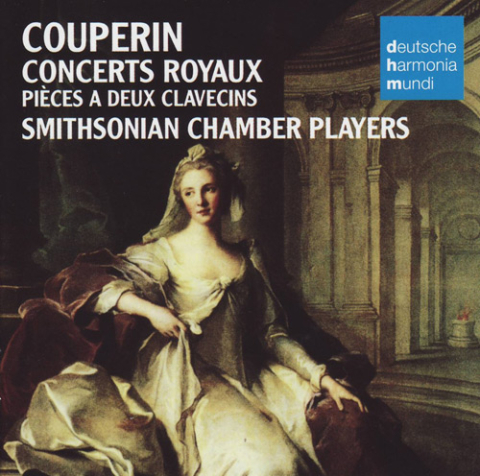
François Couperin: Concerts Royaux & Pièces à deux clavecins
The Smithsonian Chamber Players (Christopher Krueger, traverso; Stephen Hammer, oboe; Chiara Banchini, violin; Konrad Junghänel, archlute; James Weaver, harpsichord; Kenneth Slowik, viola da gamba, harpsichord, & direction)
“If God wanted to speak to man through music, he would do so through Haydn’s works; if, however, He wished to listen to music himself, He would choose the works of Boccherini.” So wrote the French violinist and composer Jean Baptiste Cartier in his 1798 anthology L’art du violon. Starting in 1818, the Parisian firm Janet et Cotelle began to issue a monumental collection of 93 Boccherini quintets for two violins, viola, and two celli. Later, Boccherini’s name surged into prominence when, beginning in Paris about 1874, a certain minuet—heard in the sample below—began to enjoy unprecedented popularity, evidenced in the myriad guises in which it was published, which ranged from simple piano transcriptions to arrangements for two mandolins, for accordion, for a cappella choir (with Latin text), and even for saxophone.
—from Kenneth Slowik’s liner notes
Slowik’s scoring of these works, following Couperin’s report of how they were originally played for the aging Sun King, offers a great variety of timbre and colour (enhanced by the use of “low French pitch,” at which A=392), and this is vividly conveyed in the clear, beautifully balanced recording. The music caresses the ear with its elegance, its sprightly rhythms, its delicious sonorities and its dazzling counterpoint. The programme is rounded off in sparkling fashion by pieces for two harpsichords, engagingly played by harpsichordists Weaver and Slowik: an ideal “dessert” for the French feast that precedes them.
Listen to a Sample
François Couperin (1668-1733)
Concert Royaux:
[1]–[8] Premier Concert
[7]–[11] Second Concert
[12]–[18] Troisième Concert
[19]–[25] Quatrième Concert
Pièces à deux clavecins:
[26] Allemande (9o Ordre)
[27] Musète de Choisi, Musète de Taverni (15o Ordre)